Step 1 – Zones of Control
In this step you learn what you can actually influence – and what you cannot. It is the foundation for the rest of the framework.
A short introduction
Do you recognise the feeling of working hard and still running on the spot? Of spending time and energy on things you cannot change, while what would actually make a difference is left waiting?
Most decision problems are not about a lack of information or competence. They are about putting our energy into the wrong things – fighting what we cannot control, while what we could actually do something about is pushed aside. The first step is to see honestly where your energy goes today. Zones of Control is a way of doing that: by sorting your situation into three levels – direct control, indirect control and no control – you see more clearly what is yours to influence and what you need to let go of. Everything else rests on that insight.
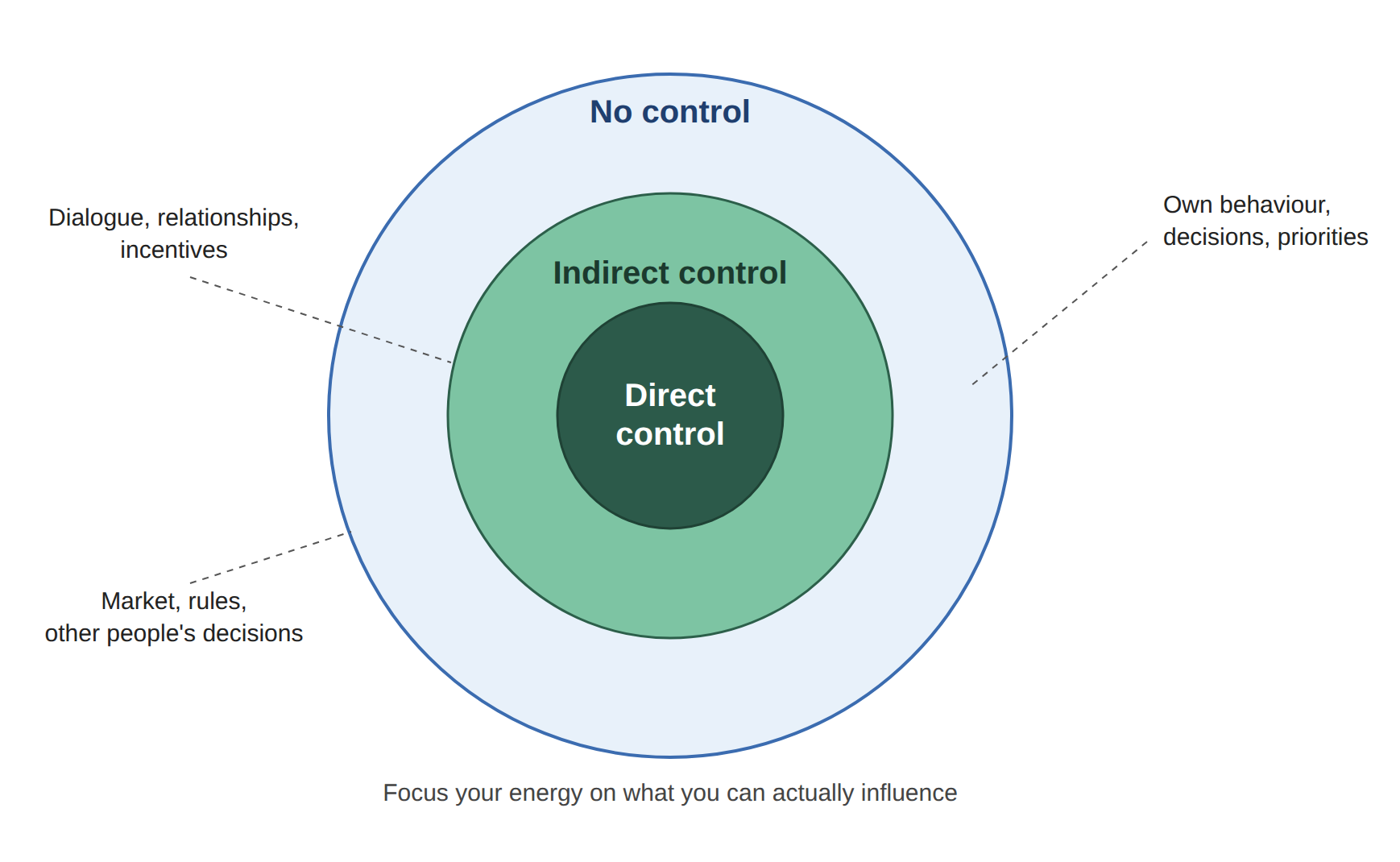
What does it mean in practice?
Direct control is what you decide over yourself – your own behaviour, your actions and the resources you actually own or manage. Indirect control is what you can influence but not decide on your own – through dialogue, relationships, incentives or structure. No control is what simply is what it is – the market, the regulations, timing, other people’s decisions. Not so that you give up, but so that you stop wasting energy on what cannot be changed anyway. The model is used continuously – not as a one-off exercise, but as a way of thinking in every decision, meeting and priority.
Common pitfalls
The most common trap is mixing up the zones. Believing you can control what you can only influence – or using the model as an excuse to avoid responsibility rather than to clarify it. Another is overestimating your own influence in complex situations, which leads to frustration when the result fails to appear.
Reflect before you move on
Take a situation you are currently wrestling with. What in it do you have direct control over? What lies outside your control – and how do you relate to that? What can you influence indirectly, through other people or processes?
Next step
Continue to Theory and background to understand the model in more detail.
